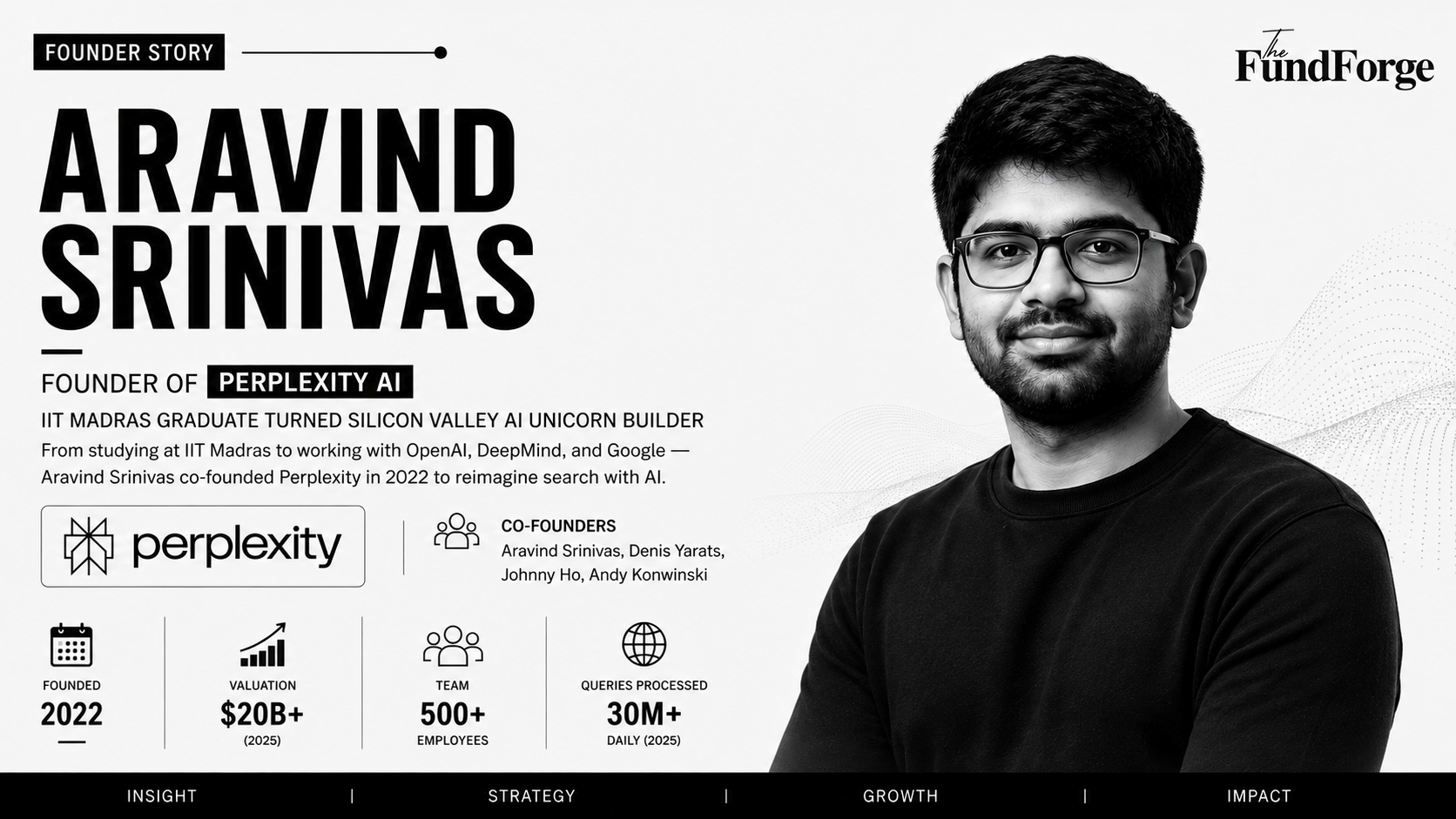
Aravind Srinivas, born in Chennai and educated at IIT Madras and UC Berkeley, co-founded Perplexity AI in August 2022 after research roles at OpenAI, DeepMind, and Google Brain. The company reached a $20 billion valuation by September 2025, and Srinivas became India's youngest billionaire at 31.
The Story
Srinivas enrolled at IIT Madras in electrical engineering, later becoming the dual-degree computer science topper after narrowly missing an early transfer cutoff.
He completed a PhD in computer science at UC Berkeley, interning at OpenAI, DeepMind, and Google Brain between 2019 and 2021 — a combination few AI researchers have matched.
During a DeepMind internship in London, a stretch of poor accommodation led him to spend nights at the office, where he discovered a book about Google's founding that planted the early idea for what would become Perplexity.
After returning to OpenAI as a full-time research scientist and contributing to DALL-E 2, Srinivas left in August 2022 to co-found Perplexity AI with Denis Yarats, Johnny Ho, and Andy Konwinski, betting that AI-generated, cited answers would prove more useful to users than traditional link-based search.
The company scaled rapidly, raising over $1 billion across eight funding rounds from investors including Jeff Bezos, Nvidia, Databricks, and Yann LeCun, and reaching a $20 billion valuation in September 2025 — doubling from $9 billion less than a year prior.
Perplexity now processes over 30 million queries daily and entered India at scale in early 2025 through a partnership with Bharti Airtel.
Business Insight
Perplexity's growth illustrates how deep technical credibility, built through research roles at multiple frontier AI labs, can translate directly into founder credibility and fundraising velocity in a capital-intensive category like foundation-model-powered products.
Srinivas's decision to leave OpenAI just before ChatGPT's public launch — without knowing what was coming — also underscores how conviction-based timing, rather than perfect information, often defines category-defining founder decisions.
The FundForge Take
Srinivas's rise to India's youngest billionaire at 31 reflects a broader shift in how quickly AI-native companies can reach massive valuations relative to prior technology cycles.
As Perplexity expands beyond search into agentic products like its Comet browser, the more interesting question isn't whether it can keep raising capital — it's whether "answer engines" become a durable, standalone category, or ultimately get absorbed into the same large platforms they were built to challenge.