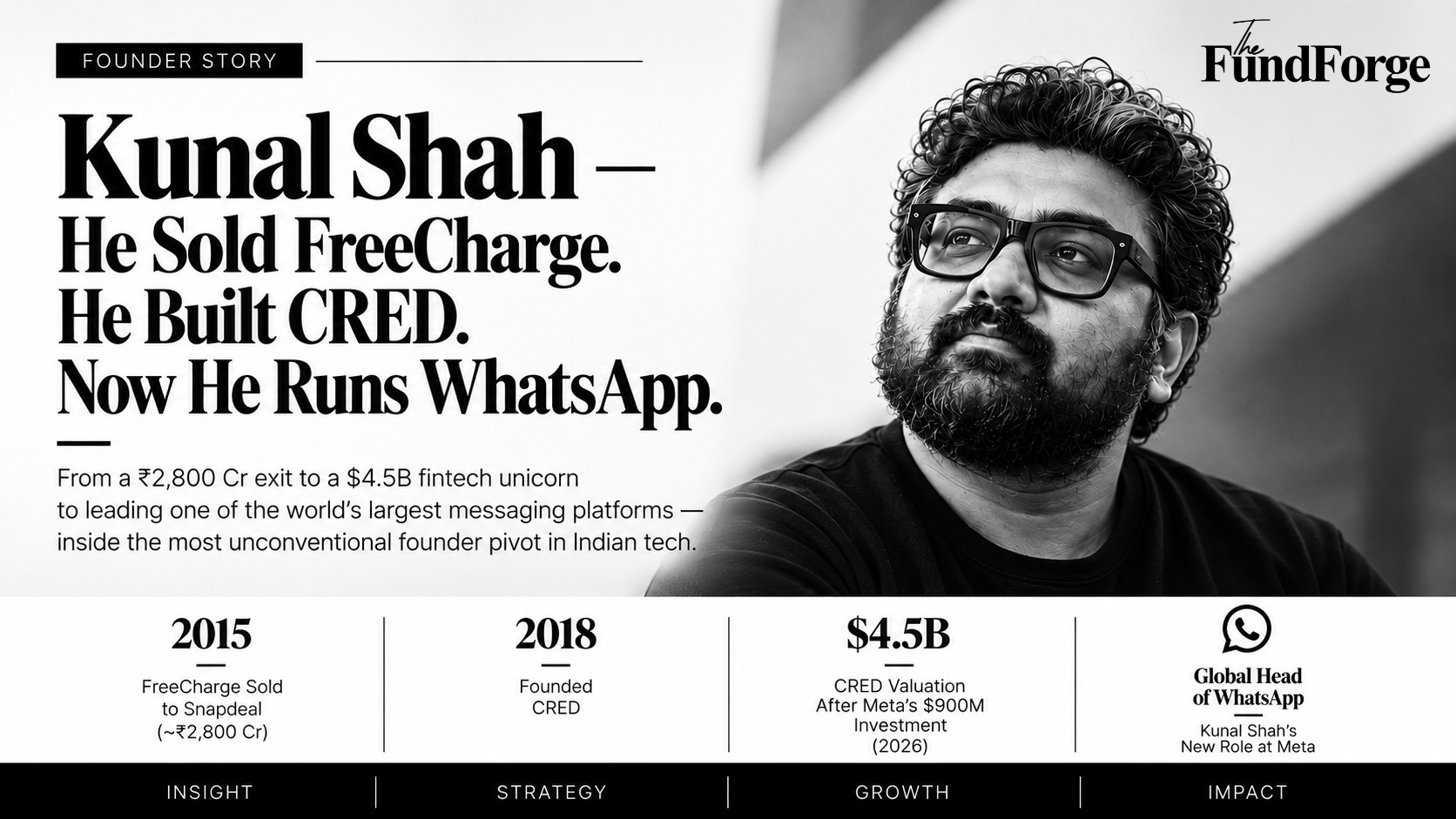
Kunal Shah sold FreeCharge to Snapdeal in 2015 for roughly ₹2,800 crore, then built CRED into a $4.5 billion fintech powerhouse.
In June 2026, following a $900 million investment from Meta, Shah stepped down as CRED's CEO to become Meta's Global Head of WhatsApp.
The Story:
Kunal Shah's first major exit came in 2015, when FreeCharge — the mobile recharge and payments platform he co-founded — was acquired by Snapdeal for approximately ₹2,800 crore.
Rather than retire on the win, Shah returned in 2018 with an idea many dismissed: a members-only app that rewarded people for good credit behavior, at a time when that wasn't even understood as a market need.
CRED took years to prove its model, but by 2026 it was processing over 40% of India's credit card bill payments, serving 17 million monthly active users, and generating around $325 million in annual revenue — profitably.
That success caught Meta's attention.
In June 2026, Meta invested $900 million into CRED at a $4.5 billion valuation, becoming a minority stakeholder without gaining access to customer data.
In the same announcement, Shah stepped down as CEO, handing the role to long-time CRED executive Miten Sampat, and took on a new global role: Head of WhatsApp at Meta, succeeding Will Cathcart.
Business Insight:
Shah's pattern — building a company through its hardest, most doubted years, then exiting near its peak rather than clinging to founder-CEO identity — is rare in Indian startup culture, where staying on is often treated as the only legitimate path.
His trajectory suggests a founder optimizing for impact and challenge over control.
The FundForge Take:
Most founders are remembered for one company. Kunal Shah may be remembered for how he left two.
In an ecosystem obsessed with "founder mode" and staying at the helm forever, Shah's decision to step away from CRED at its highest valuation — and take on a completely different global mandate — is a quiet rebuttal to that orthodoxy.
Sometimes the most powerful move a founder can make is proving the company no longer needs them.