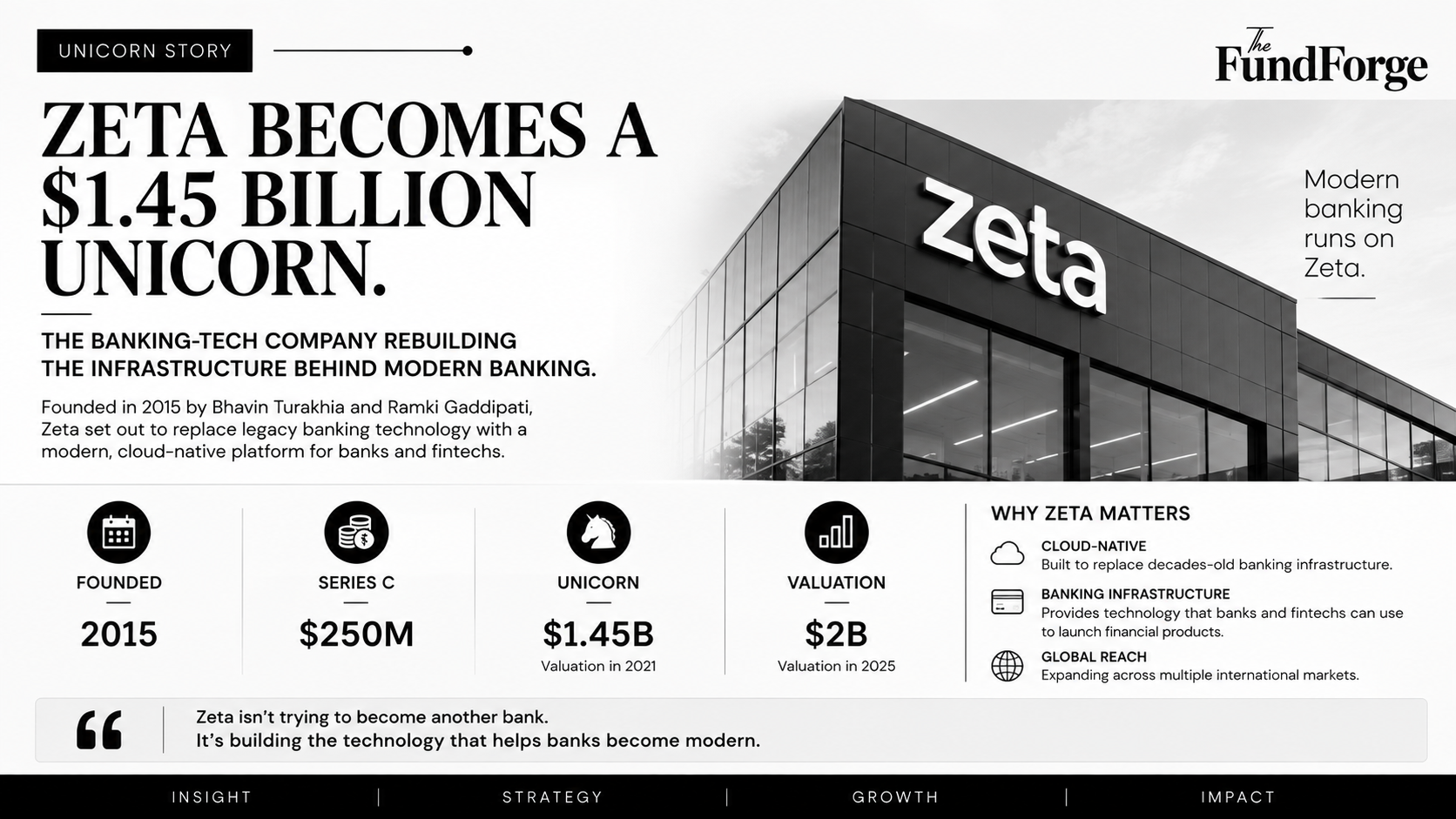
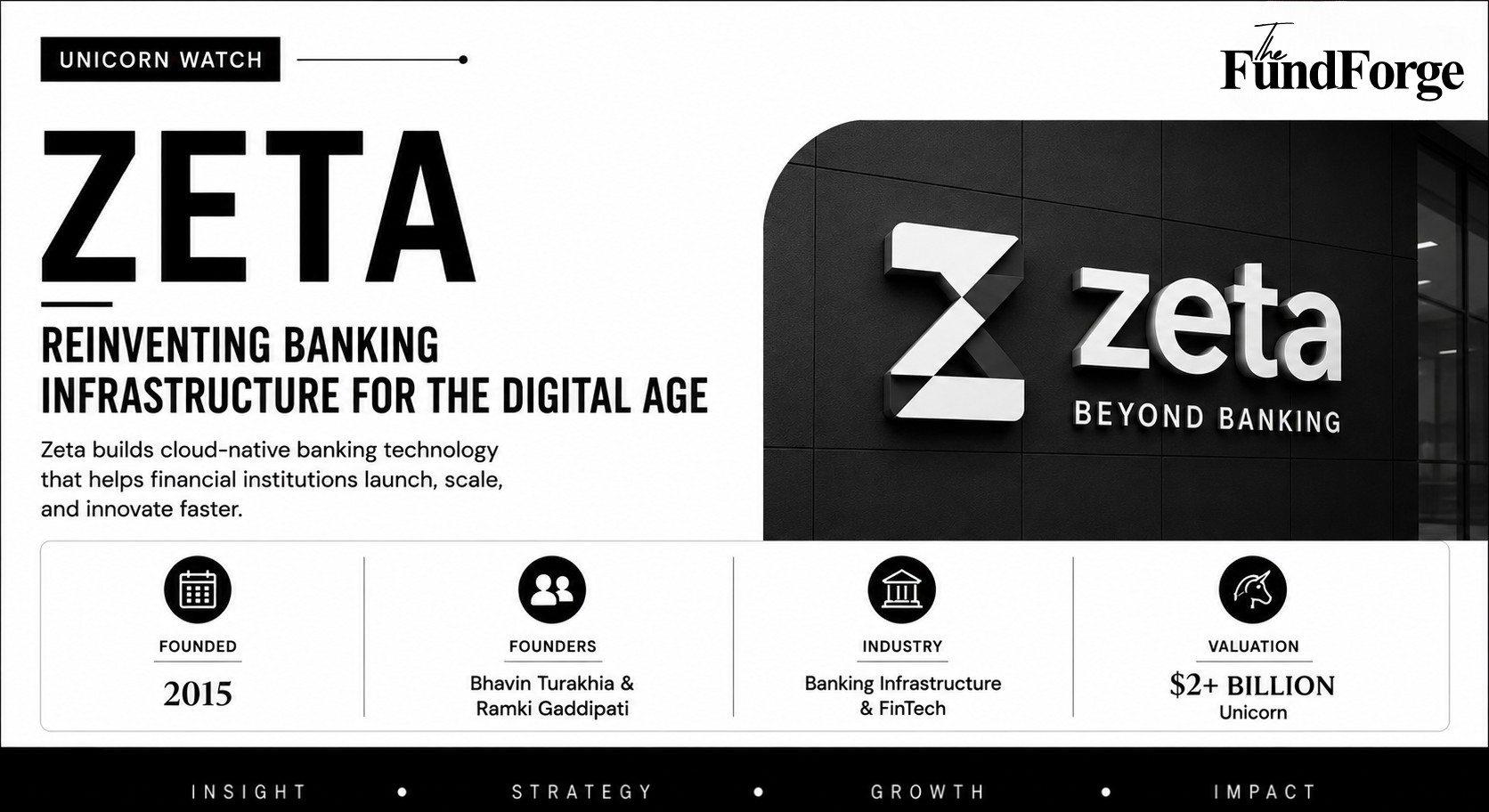
Founded in 2015 by Bhavin Turakhia and Ramki Gaddipati, Zeta builds cloud-native infrastructure for banks and fintechs. The company crossed unicorn status in 2021 and reached a $2 billion valuation in 2025.
The Story
Bhavin Turakhia, who had already built and sold several web companies for a combined $160 million by 2014, co-founded Zeta with Ramki Gaddipati in 2015 to address a persistent problem in global banking: most financial institutions still operate on mainframe systems significantly older than the customers they serve.
Zeta's first outside funding came in 2019, when Sodexo took a minority stake at a $300 million valuation.
The company crossed unicorn status in 2021 with a $250 million Series C round led by SoftBank Vision Fund 2, valuing it at $1.4 billion.
In 2025, a $50 million strategic investment from healthcare company Optum pushed Zeta's valuation to $2 billion, a 70% increase from its prior round.
The company's flagship platform, Tachyon, is a fully cloud-native, API-enabled banking stack supporting issuance, processing, lending, core banking, and fraud and risk management, now powering more than 25 million accounts with contracts to add 25 million more.
Business Insight
Zeta's growth illustrates the scale of opportunity in unglamorous financial infrastructure.
Rather than building a consumer-facing fintech product, the company targeted the deepest layer of banking technology — core processing systems — a category with enormous switching costs but correspondingly enormous stickiness once adopted, as evidenced by flagship deployments with HDFC Bank and backing from Mastercard.
The FundForge Take
Turakhia's comparison of core banking modernization to the earlier enterprise shift toward cloud computing is a useful lens: that transition took over a decade to fully play out industry-wide.
Zeta's $2 billion valuation reflects confidence that a similar multi-year migration is now underway in banking infrastructure specifically — with Zeta positioned to be the vendor banks migrate to, rather than build in-house.