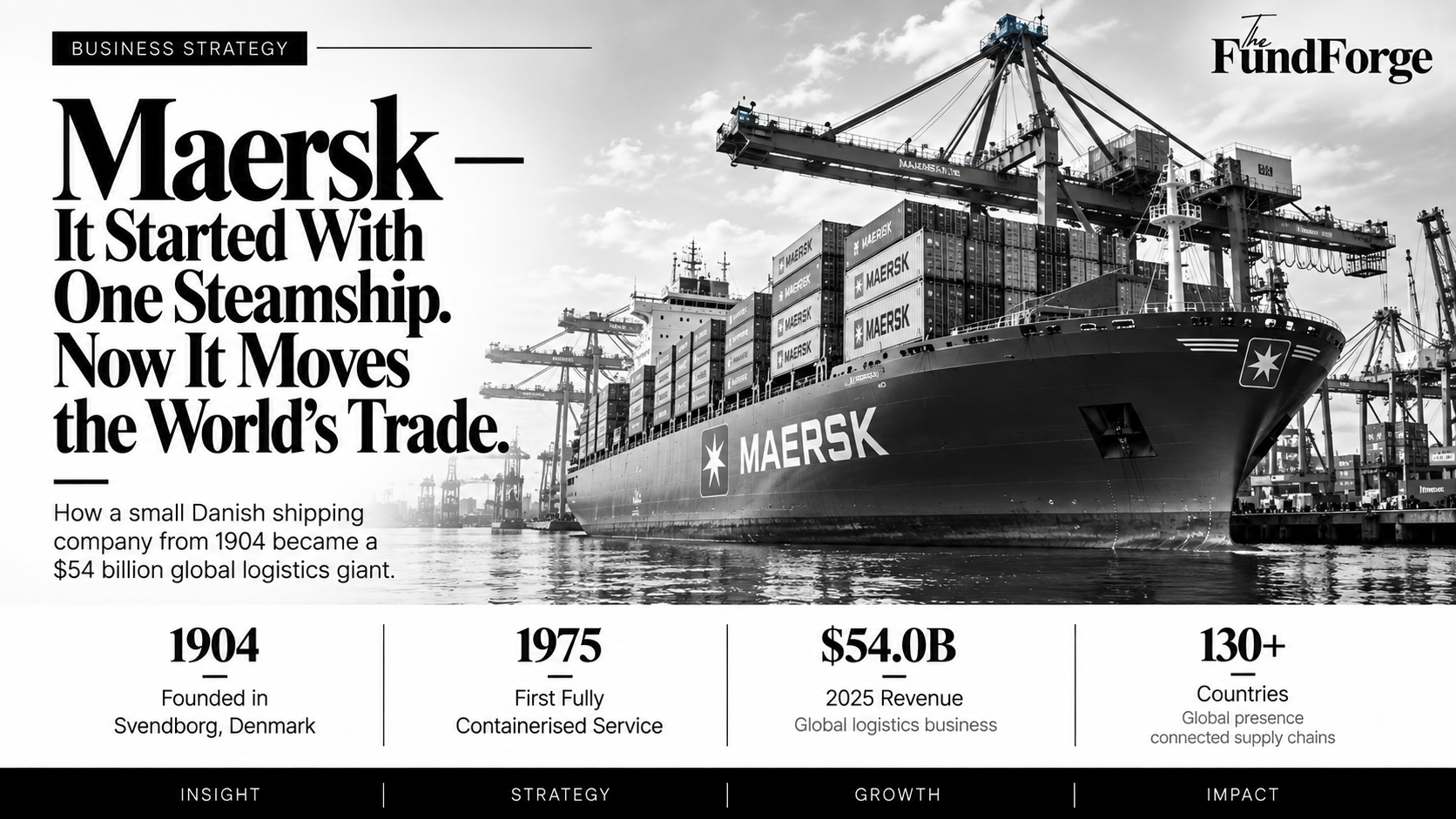
Maersk began in 1904 in Svendborg, Denmark, and grew into a $54 billion logistics group.
By restructuring into an integrator of ocean, logistics and terminals, it is positioned to profit from a volatile trade era.
The Story:
Peter Mærsk Møller bought his first steamship, LAURA, in 1886. In 1904 he and his son A.P. Møller founded the company that became Maersk.
Maersk Line launched in 1928, and in 1975 the ADRIAN MAERSK began the company's first fully containerised service.
During the 1990s, Maersk expanded from 40 countries to more than 100. In 2016 it separated Transport & Logistics from Energy to focus on moving goods.
In 2025, revenue was $54.0 billion and EBITDA was $9.5 billion, with Terminals posting record results. In August 2026, after a strong Q2, it raised full-year EBITDA guidance to $10.5-12.5 billion.
Business Insight:
Container shipping is cyclical and exposed to geopolitics. Maersk's strategy is to own more of the chain, from ships to port terminals to warehousing, so earnings do not rest on freight rates alone. Terminals' record year in 2025 shows why that matters.
The FundForge Take:
A century-old shipping line that keeps reinventing its model is rare.
Maersk's real asset isn't its fleet but its willingness to restructure, cut costs and rebuild around the next disruption.