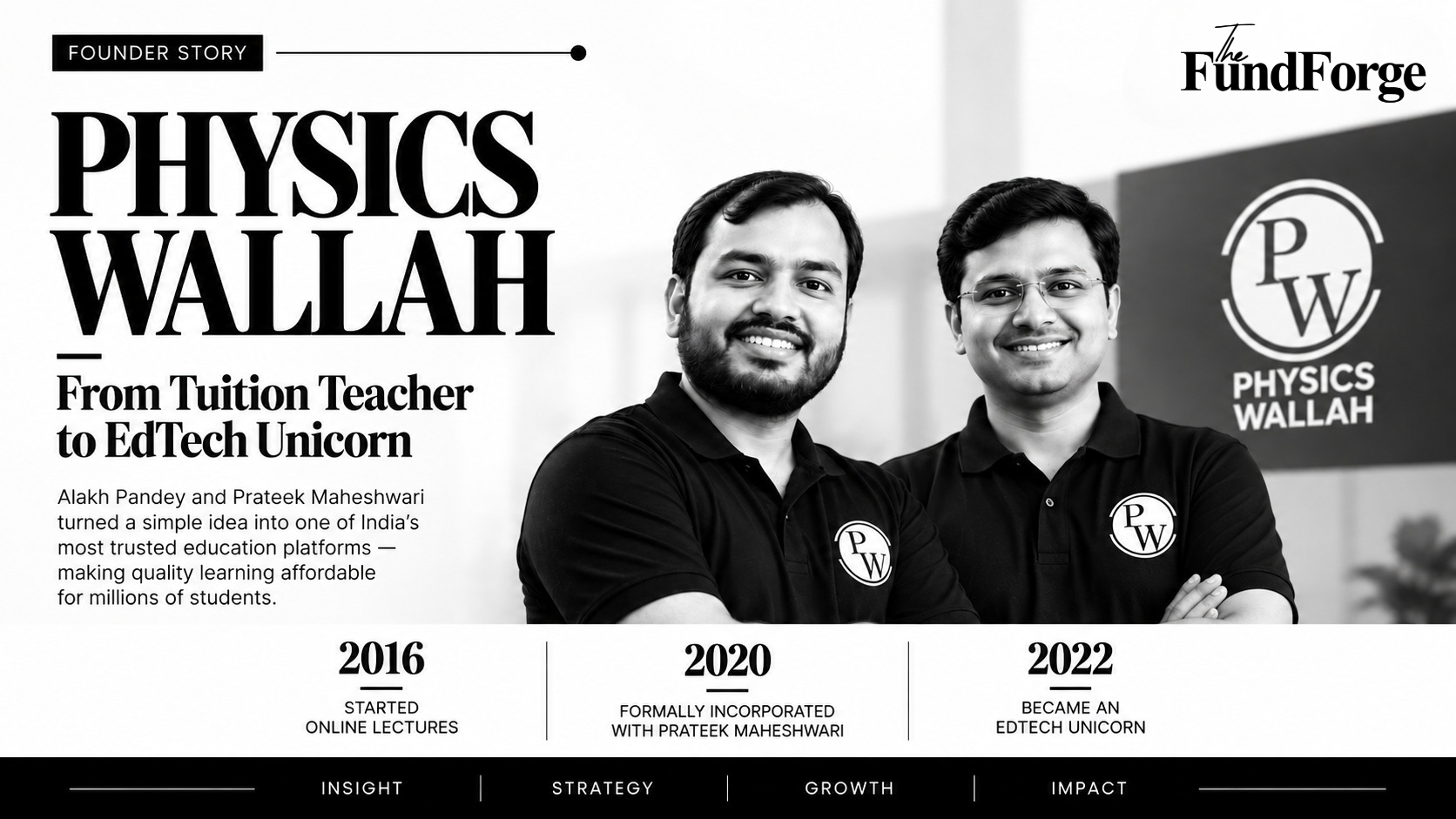
Alakh Pandey started posting free Physics lectures on YouTube in 2016, formally incorporated Physics Wallah with co-founder Prateek Maheshwari in 2020, and built it into a profitable EdTech unicorn by 2022.
The Story
Pandey dropped out of mechanical engineering studies to teach Physics at a coaching institute in Allahabad.
He'd never cracked the IIT entrance exam himself, having never had access to quality education growing up — an experience that shaped what he built next.
In 2016, he began posting free lectures on YouTube, focused on students who couldn't afford India's expensive coaching ecosystem.
The channel grew into India's largest education community on the platform, prompting Pandey and Prateek Maheshwari to formally incorporate Physics Wallah in 2020 and launch the PW app, offering full-year courses at ₹4,000 — dramatically undercutting competitors charging upward of ₹1.5 lakh.
The company reached unicorn status in 2022 with its very first institutional funding round, notably profitable since inception, a rarity in Indian edtech. PW has since expanded into offline coaching centers and listed publicly in 2025.
Business Insight
Physics Wallah's growth illustrates how deep, authentic understanding of an underserved customer's constraints — in this case, affordability — can build a defensible business model years before formal funding arrives, provided the founder is willing to operate at radically lower price points than incumbents.
The FundForge Take
In a sector still reckoning with the aftermath of Byju's collapse, Physics Wallah's profitability-first approach stands out as a genuine counter-model.
Its path from a free YouTube channel to a public company suggests that in edtech, sustainable unit economics may matter more than growth-at-all-costs funding rounds.