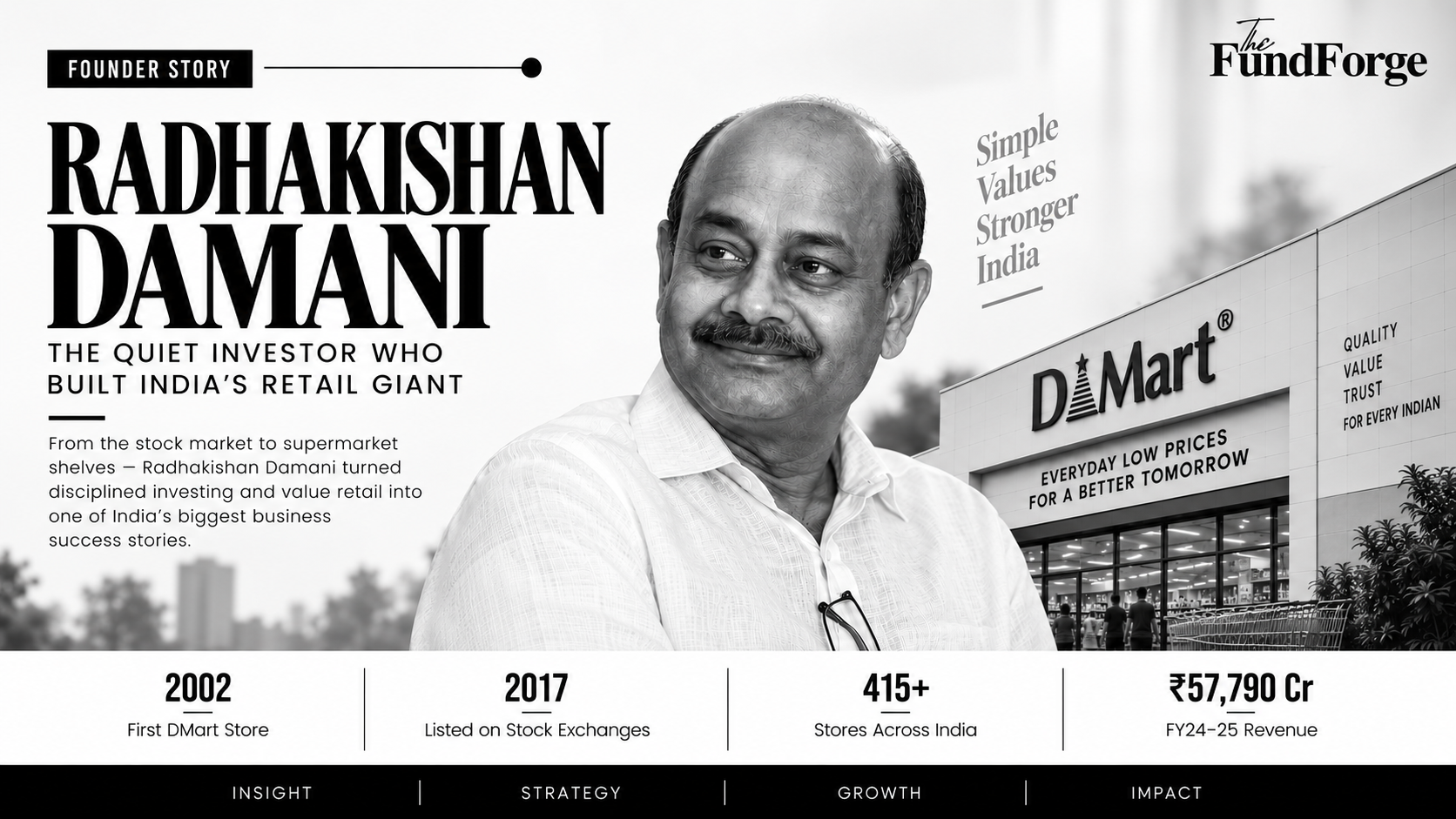
Radhakishan Damani opened the first DMart store in Powai, Mumbai, in 2002, building it into India's largest and most profitable retail chain — entirely without outside funding, media interviews, or a public persona.
The Story
After his father's death, Damani dropped out of college in his 20s to run the family's small ball-bearing trading business, later moving into stock market investing, where he built a reputation as one of India's sharpest value investors through his firm, Bright Star Investments.
In May 2002, he opened the first DMart store in Powai, Mumbai — a deliberately unglamorous supermarket built around everyday low prices.
The model rested on three disciplined pillars: owning store real estate rather than leasing it, prioritizing fast-moving inventory to cut holding costs, and expanding only in tight geographic clusters once operations proved efficient.
DMart went public in 2017, and its IPO made Damani India's new "retail king." The company has since grown to 415+ stores across 12 states, generating ₹57,790 crore in FY24-25 revenue — all while Damani has remained almost entirely out of the public eye, giving no interviews and maintaining no social media presence.
Business Insight
Damani's approach illustrates that consumer-facing retail scale doesn't require a founder-driven public brand.
DMart's growth compounded through operational discipline alone — real estate ownership, inventory efficiency, and disciplined expansion — proving a repeatable model can outperform hype-driven retail strategies over the long run.
The FundForge Take
In a business landscape increasingly built around personal branding and founder visibility, Damani's near-total silence stands out as a genuine outlier — and DMart's financial results suggest that silence was never a limitation, but possibly a deliberate part of the strategy itself.