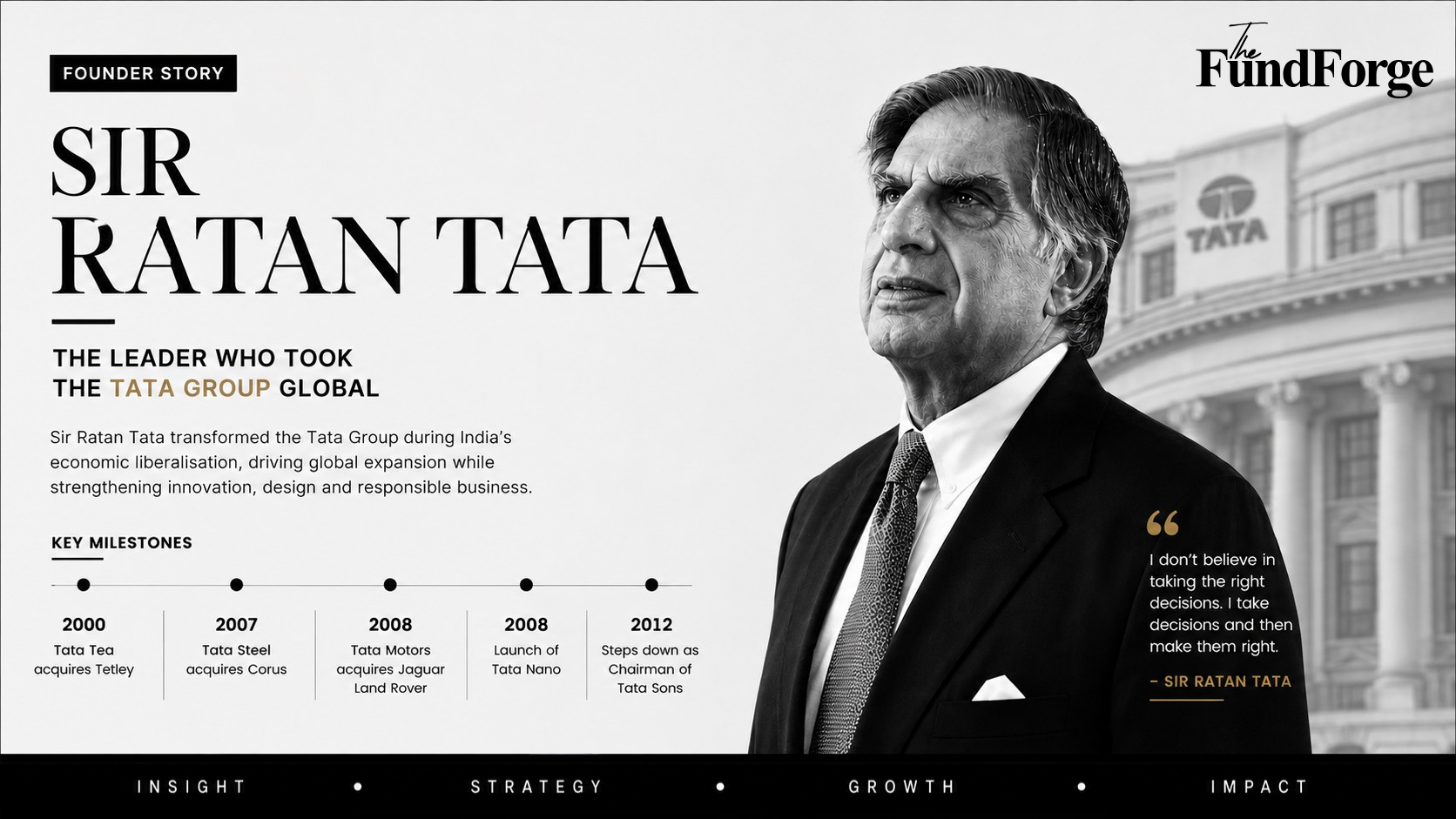
Sir Ratan Tata served as chairman of Tata Sons from 1991 to 2012, leading the Tata Group through India's economic liberalisation and a series of landmark global acquisitions, including Tetley, Corus, and Jaguar Land Rover, growing it into a roughly $100 billion enterprise before passing away in October 2024.
The Story
Sir Ratan Tata joined the Tata Group in 1962 after studying architecture at Cornell University, working through various group companies before being appointed Director-in-Charge of NELCO in 1971.
He succeeded J.R.D. Tata as chairman of Tata Sons in 1991, inheriting a conglomerate where entrenched senior leaders operated with significant independence.
His early tenure focused on consolidating authority through structural and governance changes before pursuing an ambitious global expansion strategy: Tata Tea's acquisition of Tetley in 2000, Tata Steel's acquisition of Corus in 2007, and Tata Motors' acquisition of Jaguar Land Rover from Ford in 2008, executed just as the global financial crisis began.
That same year, Tata championed the launch of the Tata Nano, positioned as the world's most affordable car.
He retired as chairman in December 2012 after 21 years, briefly returned as interim chairman from October 2016 to February 2017 amid a public leadership dispute with successor Cyrus Mistry, and stepped back permanently once Natarajan Chandrasekaran was appointed chairman.
Tata passed away on October 9, 2024, at age 86.
Business Insight
Tata's acquisition strategy illustrates a distinct model for emerging-market conglomerates entering developed markets: rather than organic international expansion, the Tata Group used large, symbolically significant acquisitions of established Western brands to establish credibility and scale almost overnight, accepting substantial integration risk and, in Jaguar Land Rover's case, crisis-era timing, in exchange for immediate global positioning.
The FundForge Take
Ratan Tata's legacy is inseparable from the governance discipline he imposed before pursuing growth — a sequencing that's easy to overlook amid the headline-grabbing acquisitions.
Growing the group from a domestic conglomerate into a roughly $100 billion, globally operating enterprise, his tenure remains a reference point for how consolidating internal authority can precede, and enable, external transformation.