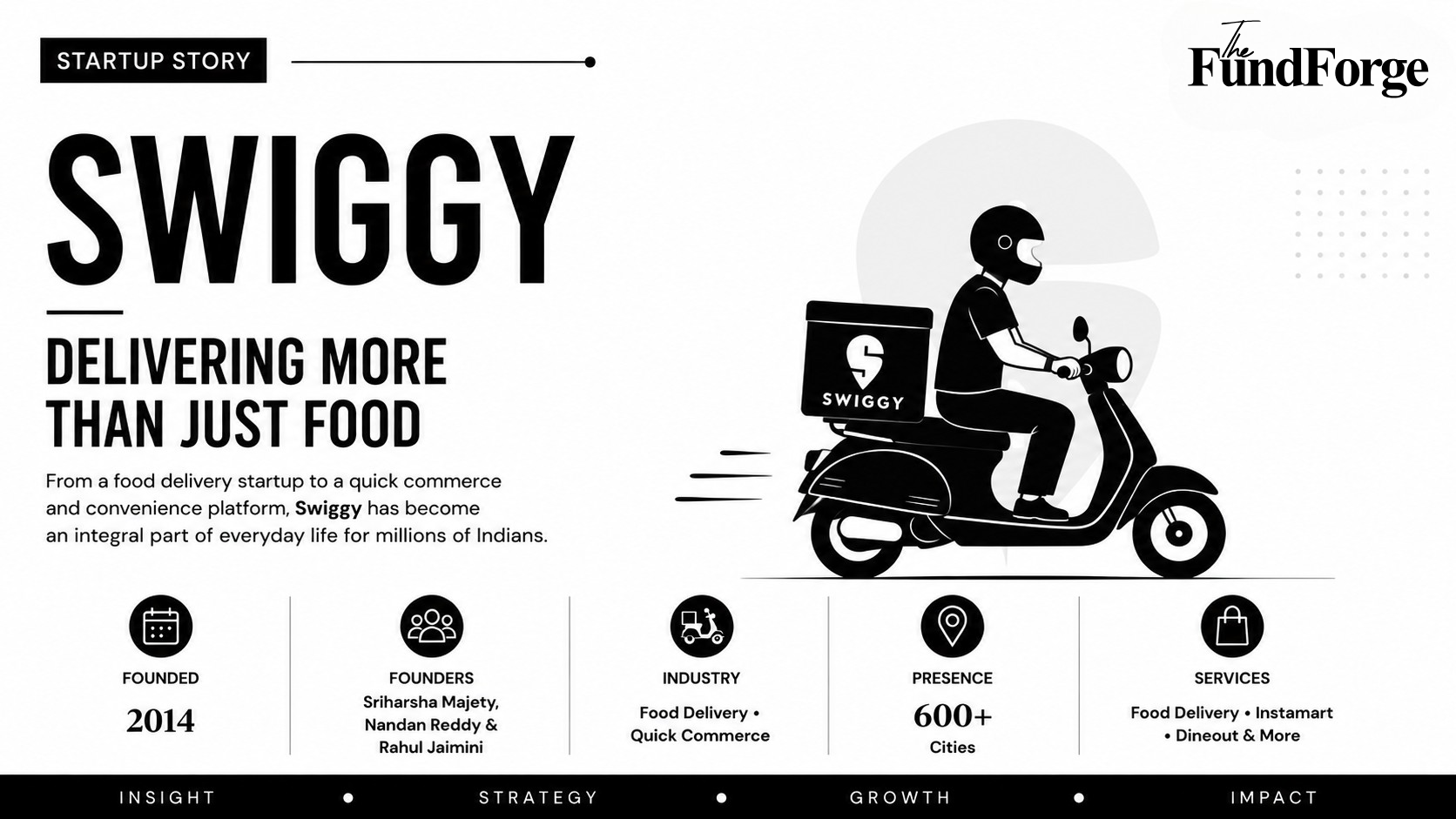
Swiggy began as Bundl, a failed courier startup founded by Sriharsha Majety and Nandan Reddy in 2013.
The pivot to food delivery in 2014, with Rahul Jaimini leading technology, built one of India's most recognizable consumer platforms — now publicly listed after a November 2024 IPO.
The Story
Majety and Reddy, both BITS Pilani graduates, launched Bundl in December 2013 as an e-commerce courier platform.
It struggled to gain traction and was shut down within a year. Rather than abandon the idea of building a logistics-driven business, the founders pivoted toward food delivery, bringing in Rahul Jaimini, then working at Myntra, to lead technology.
Swiggy launched in August 2014 across two Bengaluru neighborhoods, Koramangala and Indiranagar, differentiating itself by operating its own delivery fleet rather than depending on restaurant staff — a model that ensured consistent delivery times across every partner restaurant.
The company expanded steadily, reaching unicorn status in 2018 after raising $210 million, and diversified significantly in 2020 with the launch of Swiggy Instamart, entering the quick-commerce grocery space early.
Swiggy has since raised more than $3.6 billion across 18 funding rounds from investors including Prosus, SoftBank, Accel, and Tencent, and completed its IPO on the NSE and BSE in November 2024.
Business Insight
Swiggy's growth illustrates the value of controlling core infrastructure rather than aggregating someone else's.
By owning its delivery fleet from day one, Swiggy built a service-quality advantage that was difficult for aggregator-model competitors to replicate quickly, and that same infrastructure-first thinking carried over into Instamart's quick-commerce expansion.
The FundForge Take
Swiggy's IPO didn't mark the end of its competitive battles — the company remains unprofitable on a net basis and faces intense competition from Zomato's Blinkit in quick commerce.
Its next chapter will likely be defined less by growth headlines and more by whether it can convert 600-city scale into sustainable margins, a test that will shape how investors value India's broader consumer-tech sector.