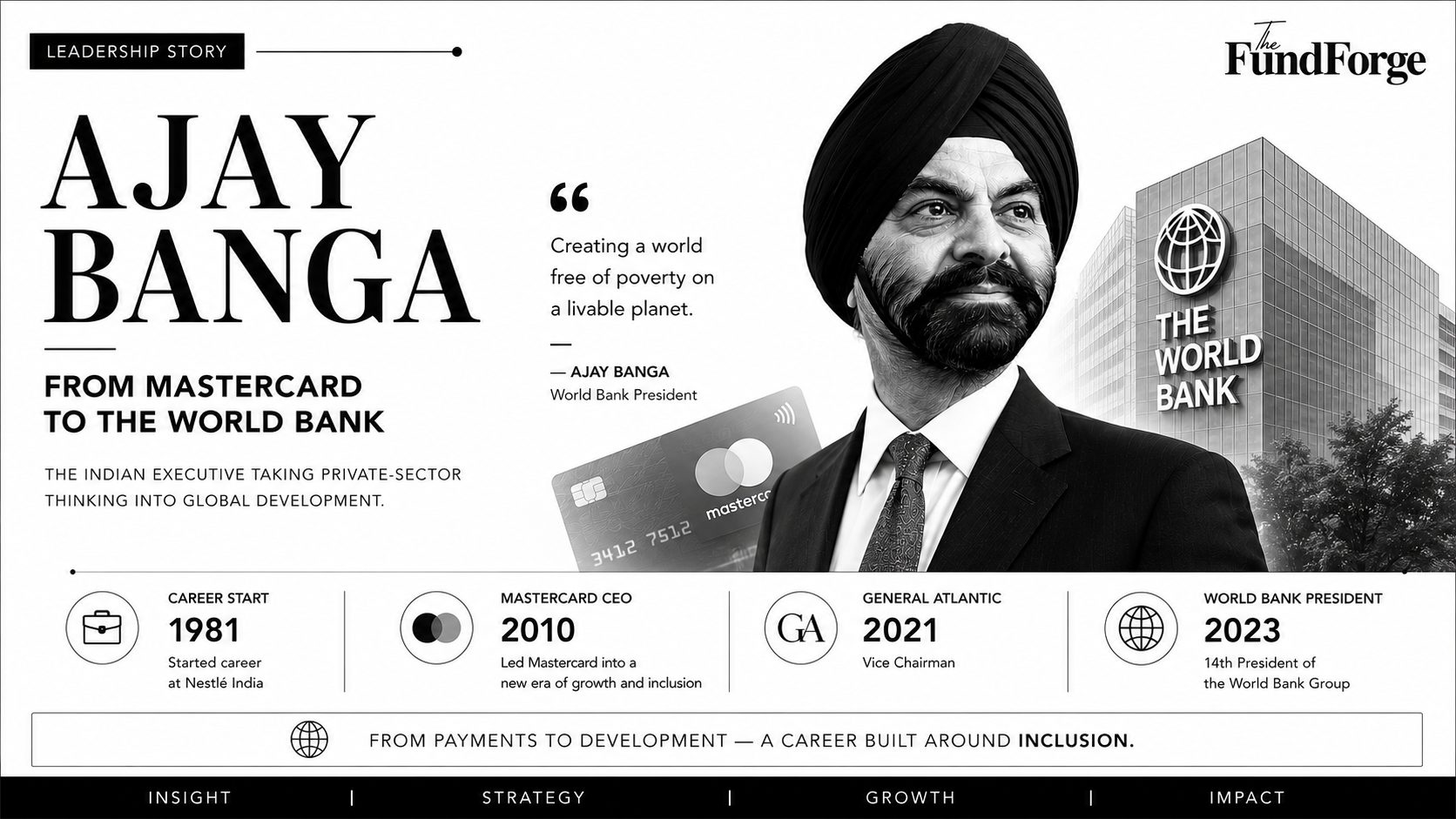
Ajay Banga began his career at Nestlé India in 1981 and rose through PepsiCo, Citigroup, and a decade as Mastercard's CEO before becoming, in 2023, the first Indian American President of the World Bank Group.
The Story
Born in Pune in 1959, Ajay Banga earned a BA in Economics from St. Stephen's College, Delhi, and an MBA-equivalent from IIM Ahmedabad before beginning his career at Nestlé India in 1981, where he spent 13 years across sales, marketing, and general management.
He later joined PepsiCo, then moved to Citigroup in 1996, eventually becoming CEO of Citigroup Asia Pacific.
In July 2010, Banga became President and CEO of Mastercard, a role he held for a decade.
Under his leadership, the company's revenue tripled and its market capitalization grew from under $30 billion to over $360 billion, while he championed the Mastercard Center for Inclusive Growth to expand financial access globally.
After transitioning to Executive Chairman and retiring from that role in December 2021, Banga joined General Atlantic as Vice Chairman, also advising its climate-focused BeyondNetZero fund.
In May 2023, following nomination by the Biden administration, Banga was elected the 14th President of the World Bank Group, becoming the first Indian American to hold the position, and began his five-year term that June.
Business Insight
Banga's appointment to the World Bank reflects a deliberate institutional bet: that private-sector operating experience, particularly in scaling financial inclusion at a global payments company, could translate into modernizing a development institution long criticized for bureaucratic slowness.
His launch of the Private Sector Investment Lab signals an explicit attempt to bring private capital and CEO-level dealmaking into a traditionally public-sector-dominated development finance model.
The FundForge Take
Banga's career illustrates a career arc increasingly relevant to global institutions: deep operating experience across consumer goods, banking, and payments, applied to development finance rather than confined to the private sector.
As the World Bank pursues his stated goals — connecting 300 million Africans to electricity by 2030 and expanding healthcare access to 1.5 billion people — his tenure will be judged on whether private-sector execution discipline can meaningfully accelerate outcomes at an institution this size.